

In June, I shared the prologue to my upcoming book, Emet: How Jews Can Reclaim Truth in an Era of Lies. I began with a story I wrote for my college newspaper about the Protocols of the Elders of Zion, an infamous forgery that supposedly revealed a Jewish plot to control the world. From there, I embarked on a path that I continue to this day, a search for not only truth, but something that has no direct English translation: “Emet.” Before you read Chapter 1, please take a look at my prologue linked below.

Now, we begin to go back further in time to my grandfather’s childhood experiences as a witness to a pogrom and blood libel in post-World War I Hungary. But this is not a history book. It’s very much about the present day and what we can do when lies pile on top of lies.
On the banks of the Danube, there is a place where the great river takes two sharp turns, making it difficult for ships to pass unseen. For centuries, this feature made the city nestled within it a fortification against foreign attack. But from an enemy inside the city’s own boundaries, there was no natural protection. And for a nine-year-old boy, hiding as his neighbors ransacked his grandparents’ home, a wine barrel was the only shelter. There he hid, silent, while around him echoed the muffled, angry, anguished sounds of a pogrom.
The year was 1918, and the place on the Danube was the Hungarian city of Paks, where the local townspeople, having endured defeat in the Great War, were venting their rage on the usual cause of all their woes—their Jewish neighbors. The boy in the barrel was Jóska Lovy. Decades later in America, he would be known as Grandpa Joe—my grandfather—the patriarch of an expanding family of doctors, engineers, entrepreneurs, soldiers, and writers scattered across their adopted nation. But for now, that future was only as thick as the wood surrounding Jóska and his brother Andor, whose grandparents believed them safe inside the casks. The townspeople would still need the barrels for the coming grape harvest, even if they succeeded in slitting the throat of every Jew in Paks.
Inside, Jóska’s senses were assaulted with contradictions. First was the scent of old oak mixed with the sweet memory of Pesach—the wine soaked into the barrel calling up the laughter of family at Passover, the holiday chocolates, the drop of wine he had been allowed in his cup for the first time the year before. He had always thought of drunkenness as a kind of silliness or happiness, the way the adults sang Chad Gadya late into the seder, the words progressively more slurred. A jumping, joyful, Jewish, therefore holy drunkenness—festive and light and harmless. He would never have thought to tie the two together: drunkenness and violence. Tonight, as he hid, he heard the sounds of a different kind of drunkenness, one he had not known existed.
Outside the courtyard, he heard the mob approaching, hurling rocks and chanting “Dirty Jew!” and other words he did not understand. He peered out through the cork holes that framed the terrifying images: women beaten, their clothes torn; the beards of the men plucked. He closed his eyes when they were dragged into the street and whipped. Windows shattered, distant fires snapped, and deranged laughter came near his barrel and then dopplered away. It was not so much what he saw that terrified him—a frightened face here, shards of glass there—but what he heard: the incomprehensible sounds of terror among familiar voices. He recognized neighbors darting past, carrying paintings, silverware, even clothing. As the air filled with drunken hate songs and Jewish pleadings for mercy, Jóska curled up inside the cask and drifted off to sleep.
He woke to an enormous crash. The mob had reached the house. Through the cork hole, the darkness revealed flames from the Jewish homes and stores; across the street, a Jewish-owned grocery was burning.
He wished he could run upstairs and fetch the “magic yarmulke”—the beaded kippah with kabbalistic inscriptions, given to the family by a famous Chasidic rabbi, said to have healed his father as an infant. Jóska did not believe in mystical Judaism; he felt there must be a more logical explanation. But there was no telling what properties it might contain. Everything was connected if you looked deeply enough. After all, an ancestor of his, Rabbi Yehudah Loew of Prague, had placed one word—emet—on a lump of clay, and the clay had become a protector of the Jewish people.
But he had no magic yarmulke, no golem.
Then the next thing he was aware of was silence. Through the cork hole, he saw Jews. Jews in uniforms. Jews who had served Hungary in the Great War. He saw Jews with guns. Within minutes, he and his brother were told it was safe to come out.
Outside, the burning scent overpowered him. Across the street stood the charred wreckage of the grocery, and on the ground sat the proprietor and his wife, their faces marked with dried blood from head wounds. They had been dragged out and beaten in front of their children. What struck Jóska was not the blood but their faces—not crying, not humiliated, simply numb, blank, containing neither scowls nor the warm smiles with which they had always greeted him. His grandparents had spoken of them only with respect; they extended credit to anyone who needed it, Jew or not. But during the pogrom, all of that was forgotten, and they were simply Jews. It was as if a switch had been thrown inside his gentile neighbors, and they, too, were no longer human. They were monsters. For the first time, but not the last, Jóska wondered what tells the human mind when to switch into this monster mode.
***
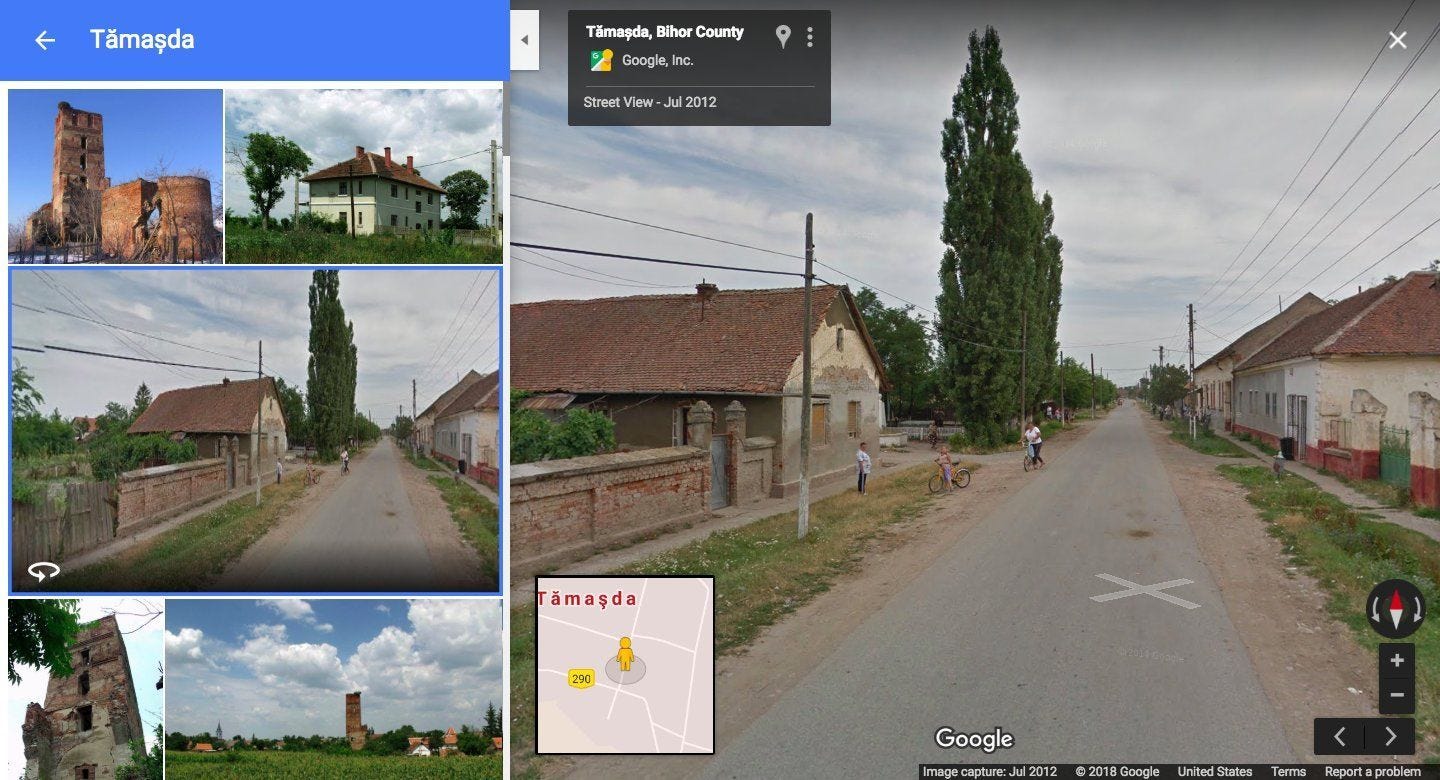
About two hundred miles to the east of Paks was the village of Tămașda, where Jóska had been born and spent the first seven years of his life. The Lövy family had many real estate holdings there and in the surrounding countryside. The business property and living quarters stood in the center of the village square, on a corner lot near City Hall, across from a church and a public school, behind a high brick fence and an iron gate locked at dusk and opened at dawn. The family business was like many others that mushroomed and peacefully flourished in Jewish hands all over Europe.
One night in the summer of 1913, a knock came at the gate, which sent the dogs barking and running. The chief of the local gendarmes, a friend of the family in ordinary times and an enemy whenever it was convenient, arrived with members of his force and a pack of customs officers from the district office. A man had reported that “the Jew” was dealing in illegal raw tobacco. It was the town drunk who had made the accusation—prompted, as far as Jóska’s grandfather could tell, by the saloon innkeeper, who had been denied some extra credit—but nothing was more believable, or more gratifying, than to catch a respectable Jew at something. A conviction could mean a few days in jail, a fine, even twenty-five lashes in a public place. The gendarmes searched all night and found nothing.
***
Back in Paks, in the spring of 1919, around Passover, the matzoh-bakery ovens in the temple courtyard were fired up, and the community was glad the harsh winter was behind them. The bakery had supplied Paks and the surrounding areas for generations. A few days before the holiday, the workers had been paid and discharged, and the Chasidim took over to bake the special shmurah matzoh, which could be touched only by the sabbath-observant.
That was when an agitated couple arrived from the nearby German-speaking village of Duna-Kömlőd—Swabians, who employed themselves on small farms and carefully cultivated their antisemitism, and who were among the first to turn on their Jewish employers in times of pogrom. Their daughter, Julcsa, had worked in the bakery for months and had not come home the night before. The Chasidic men assured them she had taken her pay and left for the season, as the workers did. But the next afternoon, a cartload of noisy young people returned with the parents, and with the priest Fenyes, fresh from preaching the Easter crowds into a fury, along with some gendarmes and local politicians, all demanding the whereabouts of the sweet Christian girl.
Jóska watched the synagogue courtyard fill with people shouting an accusation he had not heard before. He knew the myths—Christ-killing, money-grubbing, all the rest—but no one had told him about the blood libel. “It is just like Tiszaeszlár in 1882!” shouted a local gentile scholar—the case in which Jews had stood trial for beheading a fourteen-year-old Christian girl and using her blood to make matzoh. The press had whipped the country into a frenzy then, and the myth of Passover ritual sacrifice had never died. Watching the courtyard, Jóska understood the situation was sliding toward the same thing.
Two groups faced each other, divided only by a few non-Hungarian soldiers: on one side the Jews, crying, praying, cursing; on the other, people—some of them neighbors Jóska knew—yelling threats of murder and extermination. The children were kept in a knot, ringed by older boys and a young man who had served in the Great War. The gendarmes searched the bakery and the temple complex with new fervor. Not a trace of Julcsa could be found. It was going to be a very long night, and only a few soldiers with guns stood between the community and a historically bloody event.
Then, out of the dark, from the main gate, came a shout: “Mom! Dad!” For an instant, the entire courtyard froze—fists raised, knives and clubs at the point of being drawn. It was Julcsa. Dominating the gate stood a husky farmer, red with rage, gripping the girl with one hand and a boy of about the same age with the other. He came within centimeters of her parents’ faces, and his voice boomed for all to hear. “How did you raise your daughter?” he shouted, spittle striking her father. “She is a whore! Take her home with this boy. I don’t want to see them again, or their Swab bastard.” And he turned and left for home.
The crowd stood with mouths suspended mid-yell, fists and sticks and pitchforks still in the air. Then, muttering, it broke apart and found its way through the gates and home.
Later it came out that Julcsa and her boyfriend, Pista, both worked at the bakery—she a Swab, he a Magyar, the two peoples hating each other, so Pista had never brought her home. The affair had flourished unseen. Her father, hearing the girl was missing in Paks and knowing his son worked there, had ridden into town, found them together in the stables, and dragged them barely dressed to the temple courtyard. The Jewish community kept its doors closed and windows protected for days. It was shaken.
For Jóska, it was educational in more ways than one. But what he never forgot was the disappointed look on the priest Fenyes’s face. Fenyes had wanted an excuse to drive the Jews out of Paks once and for all, and the truth had robbed him of it.
***
That boy became my grandfather, and whenever I reach into myself to define what Jewish values are, what Jewish morality is, I find I am describing Joseph Lovy. To me, he is the template for Judaism itself: for how to treat your fellow man, for honesty, for standing up with pride as a Jew. And yet everything you have just read, he carried inside him before he was eleven years old. He became the man I admired not despite what he had witnessed, but because of it. He had seen, as a child, how cheaply the truth could be discarded and how lethal the lie that replaced it could be. That refusal to believe the lie is what I inherited. I absorbed my family’s history, I watched the same truth get inverted in my own time, and I stubbornly chose his way: to live according to the truth as he embodied it. I did not always succeed, and I still fall short, but it is the tune I wake up to in my head every morning. I ask my grandfather what he would do.
But before I go further, I need to pause and make one thing clear. I am not saying that truth-telling will ultimately prevail over lies. It may not, and I would not be so naïve as to insist that it will. If the lesson of my grandfather’s childhood were “hold to the truth and you will be protected,” I would be writing a different book—a feel-good self-help tome.
The real lesson is harder, and my grandfather lived it: you hold to the truth even though it will not protect you, because it is the only ground solid enough to stand on while everything else gives way. That is the difference between optimism and Emet. Optimism says the truth wins. Emet says the truth is worth keeping because the alternative is to become the very thing that oppresses you.
Throughout history, Jews have had many names for that thing—Jew-hatred, antisemitism, antizionism—but the real enemy has always been the lie: the lie that spreads from your neighbor’s house to entire nations. They are lies about who Jews are, what we believe, what our books say, how we practice our religion, and our relationship to our land. And if you give in to the lie, if you think for one second that “they have a point,” then you have strayed from Emet. You have strayed from the truth.
This is not to say there cannot be disagreement about what the truth is. Judaism has been an argument from the start—with God, and with each other—over how to live, how to practice, how to fulfill the commandments. “Two Jews, three opinions” is not just an old joke. It defines us. But there is a difference between an argument and an accusation, and it is a difference in kind, not degree. The lie about who Jews are is not a position in an argument. It is a weapon that only needs to be believed. The same lies have surfaced in different forms so many times, across so many centuries, that we have learned to recognize the pattern. We have seen it before. We know what it is.
What my grandfather witnessed as a child in the stories above involves two related accusations. The first is that Jews are an alien presence inside the nation, plotting against the people who host them. The second is that Jews practice secret rituals requiring the blood of non-Jewish children, the lie known as blood libel.
After the Great War, a humiliated population in Paks went looking for a reason they had lost, and the oldest available explanation was the Jews. The mob that rampaged through the town while my grandfather hid in a wine cask had no reason to blame them beyond the fact that Jews represented what they considered a foreign element in their midst. In Germany, the same impulse produced the “stab in the back” theory. In Hungary, they reverse-engineered their own.
The following spring, the communist government of Béla Kun was firmly established in the major Hungarian cities, including Paks. Kun’s regime included Jews—among them, as you will read later, a relative of mine. Now the vague resentment had a shape. The Jew was no longer merely the available target. A new phrase was coined for him: “Judeo-Bolshevism,” an expression the Hungarian right borrowed from the White forces of the Russian Civil War. Jews were accused of refusing to fight for the nation in its hour of need, a charge that was demonstrably false—as my grandfather had seen with his own eyes. The men who finally stopped the pogrom in Paks were Jews with guns, veterans who had served Hungary in the Great War.
Then came the treaty. In June 1920, at Trianon, Hungary lost two-thirds of its territory. Three million Hungarians went to bed inside the country and woke up as foreigners in someone else’s. A wound that size demands an explanation, and the explanation could not be that Hungary had lost a war it helped start. So, the charge that had been assembling since 1918 hardened into permanent national doctrine: the Jews were responsible for Trianon. My grandfather’s birthplace, the village of Tămașda, was among the territory handed to Romania. The Lövy family lost everything they had built there over generations—the property looted, the buildings burned, the family ordered out. Jóska never saw the village again. And the accusation that made it possible has never gone away. It is still present in Hungarian public discourse today.
This is how it works. One lie is laid on top of another, and another on top of that, until the pile of them becomes the ground people stand on. Alone, each could be dismissed. Together they build a picture of a people who are not quite people—foreign, disloyal, murderous, secretly in charge. Once that picture is finished, violence against Jews does not even seem to be extreme.
That is what turns a neighbor into an enemy. None of these people woke up one morning having decided to become monsters. They had simply been standing on the pile for a very long time.
And by then, it did not matter how many Jews came home with medals. It did not matter how many produced their commendations from the Great War, or how many were buried in Hungarian uniforms. The lies had become accepted truth.
My grandfather knew better because he had been there; he had witnessed the lies morph into deadly violence. My grandfather fought for the truth through the acts of remembering and retelling. He told me these stories verbally and wrote them down. He fought back against lies by refusing, for the rest of his life, to accept them as truth, and by putting the true version into his grandson’s hands.
He gave me the gift of Emet.
I have been thinking about that gift a great deal lately, because the second accusation my grandfather witnessed has come back in my own lifetime.
The blood libel is the accusation that Jews murder non-Jewish children and use their blood in making Passover Matzoh. The details are absurd on their face. A lie that requires no evidence cannot be refuted by evidence, and the more grotesque the charge, the more it demands to be believed rather than examined.
You may have encountered the term in contexts that have nothing to do with matzoh. It has become the catch-all name for the accusation that Jews are murderers—not that a particular Jew committed a particular crime, but that killing innocent people, especially children, is what Jews do.
Because classic antisemitism is still frowned upon in polite society, the charge has been relocated to Israel, the geographic location of half the world’s Jews. And so, you get Jews harvesting Palestinian organs, Jews training dogs to rape Palestinian prisoners, and other ridiculously false allegations.
Remember that the more grotesque the charges, the more believable they appear because they force Jews to deny them. And the denial becomes a feedback loop that focuses attention back on the allegation. The point is to keep Jews on the defensive.
The lies pile one on top of another until Jews are called baby killers, and it all seems plausible to reasonable people. This is how you get the former friends, colleagues, and neighbors of Jews to turn against them, and how you set the stage for violence. It begins with the blood libel.
How do you fight blood libel? In any era, you begin by recognizing the accusation for what it is, seeing the patterns etched by history, digging down through the layers of lies, and educating those who are willing to hear just exactly how blood libel is both an ancient and modern tool used against Jews. For saying so, you will be vilified by some and even face alienation from longtime friends, neighbors, and colleagues who believe the lies because they are so ingrained and repeated over and over again.
I never said this would be easy. But this is Emet.
This chapter is free to all subscribers. Subsequent excerpts from Emet will be available to paid subscribers.
Really powerful. I've been fascinated with the Tiszaeszlár affair for some time and you beautifully demonstrate the ripple effects. I haven't visited the town since apparently the girl's grave has turned into an neo-nazi attraction but I have some great photos of the commemorative plague of the trial in Nyíregyháza
Great work Howard. It’s a tough subject to read about and a tougher subject to write about, but you do not beautifully