
'Trigger Warning:' Jews Write Books
If the publishing industry won't make room for us, we'll do what we always do: succeed anyway.

In my line of work, I get a great deal of promotional material from authors and publishers. Below is an actual “trigger warning” appearing in a book description that crossed my path a while ago.
“Trigger warning: Content in this book includes depictions or mentions of ableism, antisemitism, characters struggling with mental health, death and grief, drug abuse, domestic violence, gun violence, homophobia, misogyny, racism, statutory rape, suicide, xenophobia, and Zionism.”
Wait … what?
Zionism is now on par with all the horrible things mentioned in that promo material. It’s no wonder Jewish authors are having a hard time cutting through the antizionist noise. Not only is there a bias against Jews who believe in self-determination in their homeland, it is considered an act of violence to even mention the Z word.
How on earth do you push back against this kind of garbage? Is it worth fighting anymore? Or is it time to flee and launch our own Jewish-friendly publishing houses and bookstores? This is a conversation I’ve had with many people in the Jewish literary community, both in my capacity as an editor at Judith Magazine and in my research for my book, Emet: How Jews Can Reclaim Truth in an Era of Lies.
I recently spoke to Lior Zoë Perets of The Jerusalem Report on this topic for her excellent piece, The literary world’s ‘Jewish question.’ Among other things, I told her, “If you’re not going to hire me here, I’m going to start my own publishing house, my own magazine. It happened in all professions. Eventually, these things became so successful that they became mainstream.”
I elaborated on it in a Substack note:
Even my friend and colleague Erika Dreifus, whom I’ve known for years as a fighter within the traditional literary system, expressed fatigue. She told Perets: “For a very long time, I was trying to stay and fight. [I] gradually [realized] – I’m very tired of fighting.”
And the war isn’t only being fought at the publishing level. If your book does break the blacklist and make it out into the world, good luck getting your local bookseller to stock it. In an enlightening and heartbreaking piece in Judith, authors and avid readers Teme Ring and Susan Blumberg-Kason tell of what they call The Great Betrayal. They write about how the very bookstores that had once brought them joy now say there’s no room for Jewish voices on the shelves.
Read the whole thing here:

There is a self-destructive force involved in the antizionist bias at bookstores. If we cannot find what we’re looking for in our local brick-and-mortar stores, we’ll head straight into the arms of Amazon and other online booksellers. And, yes, Jews do buy books. Strange, but true.
Rachel Goldberg-Polin's When We See You Again—her account of her son Hersh's kidnapping and murder—made the New York Times bestseller list. Former hostage Eli Sharabi's memoir did too. And, no, this is not a case of “People Love Dead Jews” a la Dara Horn. These are not Holocaust memoirs. They get at the heart of current Jewish pain, and they do not comfort non-Jewish readers into thinking that they would have helped rescue them. There are no promises of “Never Again.”
This tells me that the conventional wisdom among agents and publishers, that “this is not the right time for Jewish books,” is a self-fulfilling prophecy that has little to do with what readers want.
The consequences go beyond the careers of Jewish authors. This is a purposeful silencing of voices that need to be heard amid the roar of antizionist and antisemitic content that is now mainstream. All the libels against Jews and against Israel are platformed in special sections of your local bookstore, with no sign of the counter-narrative.
When I was querying agents for my novel a couple of years ago, I noticed that most of them, listed, with pride, that they were looking for marginalized voices. It didn’t take me long to realize that did not include Jews.
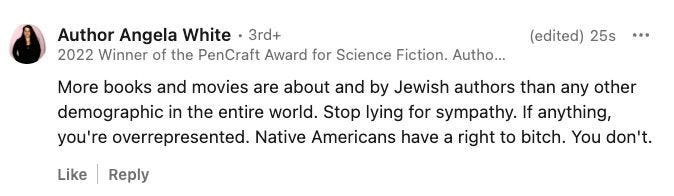
There’s a perception that Jews are already overrepresented. Here’s a message I received on LinkedIn when I posted something about my focus on editing Jewish books because we are being blacklisted in the literary community. Kind of proves the point.
I was recently informed that a trusted colleague and a kind of mentor to me had signed an open letter trashing the Jewish Book Council for doing its job on behalf of marginalized Jewish and Israeli authors. I was shattered. The trust is gone. These are times of both distress and clarity.
So, where do we go from here? Fight or flight? I don’t think the choice is as binary as it seems. Launching our own Jewish-friendly publishing houses, bookstores, and representation is not fleeing. It’s Jews doing what we’ve always done: From medicine to movies to country clubs. We show the world how to do it right.
I’m doing what I can with my largely pro-bono work at Judith and in my work as a book editor who specializes in Jewish stories. We all need to think about what we can personally do. Where do your talents lie? Set aside a portion of your workweek to provide opportunities to your fellow Jews.
As always, the rest of the world will take notice.
Trigger Warning: Jews Succeeding.
Oh Howard, how right you are on all counts. When I was shopping my memoir 8+ years ago, even then I found that my religious Jewish voice was somehow not a "marginalized" one to suit the tastes of publishers. Too bad I didn't write eco-fiction, or better yet, YA, transgender eco-fiction! As to that author who claims Jews are already overrepresented as authors, she's right! We are hugely overrepresented based on our actual population because we're a literate people, have been for 3,300 years. Don't like it? Become more literate!
I believe we should look at major publishing houses and try to establish Jewish imprints with major Jewish literary figures as linchpins. If that is not successful (even at Jewish founded publishers-- Simon and Schuster, for example), then start from scratch and create new companies. Even if they are not in the corner "antisemitic" bookstore right away, direct sales models, Amazon, other online sales companies, can be quite effective and show the way. Just like the Jewish hospitals, golf clubs, etc of the "past". Because it appears the past has returned!
PS The woman's comment about overrepresentation vs. Native American book writers is one of the elements of modern antizionism-- the end of meritocracy and the shift to a DEI mindset from an MLK-- content of character-- approach.